Le Refuge des Anges · Megève
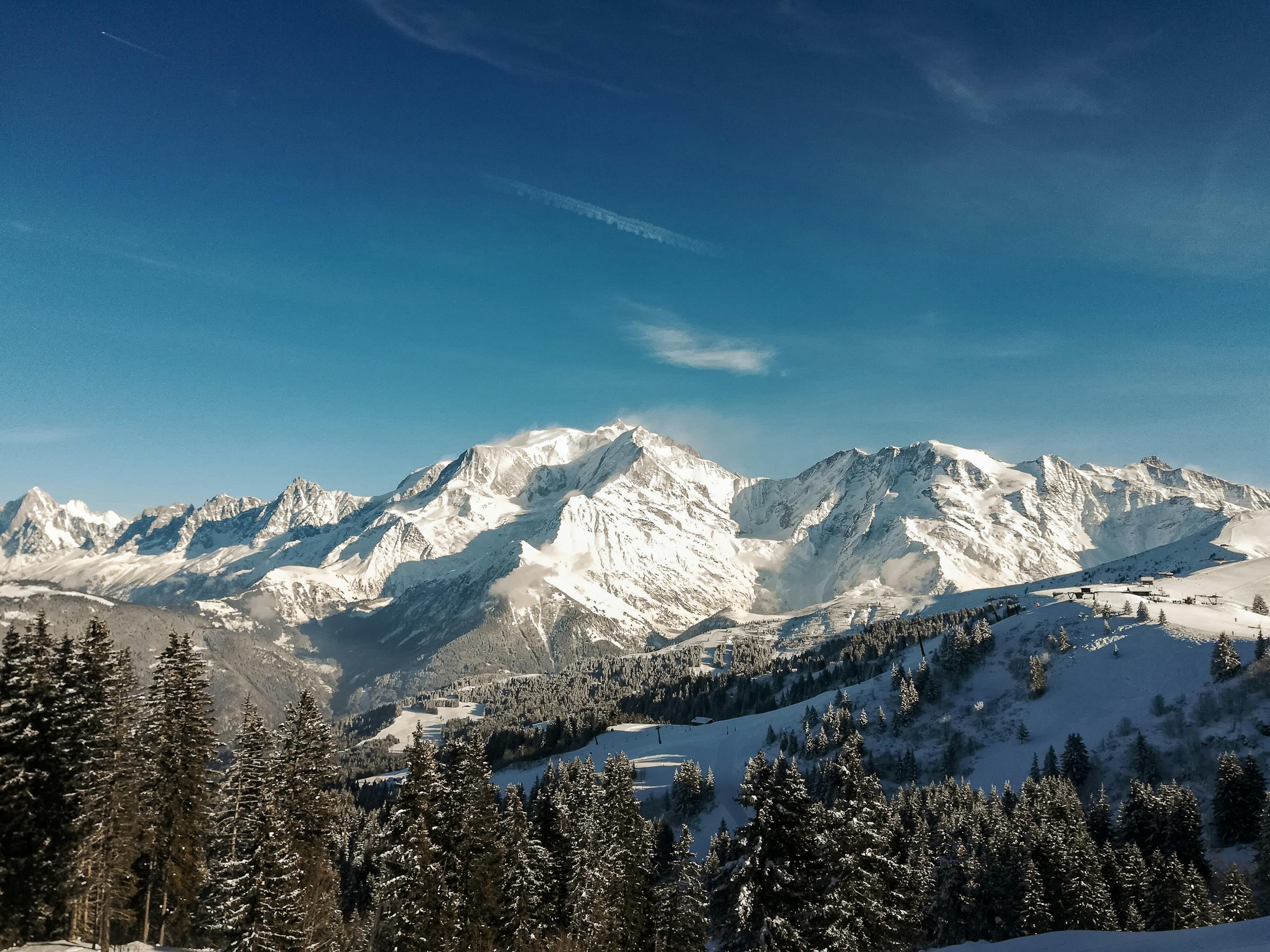
Megève in summer belongs to walkers. Two hundred and fifty kilometres of marked trails radiate from the village into the Évasion Mont-Blanc massif — from shaded forest paths along the Arly river to exposed ridgelines where the Mont Blanc fills the horizon. From Le Refuge des Anges, every trailhead is within minutes, and the mountain reveals itself at whatever pace you choose.
The village of Megève sits at 1 100 metres altitude. The massif that frames it rises to almost 2 500 metres at Mont Joly, with a dozen distinct summits, four cable-car sectors and enough variety of terrain to occupy a fortnight of walking without repetition. Meadows of wildflowers in June give way to bilberry moorland in August and the first gold larches of September. The Évasion Mont-Blanc network maintains 250 km of marked trails graded from gentle family circuits to technical mountain routes — the same infrastructure used in winter for the ski domain now serves, more quietly, the summer walker.
Most trails around Megève require no specialist equipment beyond proper walking boots, a wind layer and sufficient water. The access by cable car — several lines operate through July and August — shortens ascent times significantly and extends the hours available at altitude.
The Mont d'Arbois sector, directly above Megève on the south-east side of the village, is the most logical introduction to hiking here. The cable car from the Côte 2000 base station deposits you at 1 833 metres, from which a circular route passes through alpine meadows, across the Alpette plateau and along a ridgeline offering a continuous panorama of the Aravis chain and, on clear days, the full sweep of Mont Blanc. The loop — approximately 14 km with 600 metres of ascent — takes three to four hours at a comfortable pace. Guests of Le Refuge des Anges can complete this route as a half-day, returning to the village in time for a late lunch on the apartment's panoramic terrace.
From the Rochebrune cable car — the original Megève lift, built in 1933 — a trail climbs to the Croix de Salles at 2 021 metres: the most accessible high-altitude summit from the village. The ascent from the upper station is a steady 45 minutes on well-signed terrain. The cross commands a full 360-degree view: the Aravis to the south, the Mont Blanc massif to the east, and Megève itself — miniature and precise — directly below. An essential first hike for guests arriving at Le Refuge des Anges who want to read the landscape before venturing further into the massif.
Not every walk in Megève needs to be an ascent. The valley floor along the Arly river — between Megève, Combloux and Praz-sur-Arly — offers a flat or gently rolling network of forest paths suited to families, to mornings after long evenings, or simply to those who prefer trees and birdsong to exposed ridgelines. Several sections pass through old chestnut and spruce woodland unchanged for centuries. The 8 km circuit from Megève village to Praz-sur-Arly and back follows marked trails without any significant climbing and takes approximately two hours at a quiet pace.
Reached by the Joran gondola from the Saint-Nicolas-de-Véroce sector, Plan Joran at 1 940 metres is a high pastoral plateau where cattle still graze through summer under the care of farming families who have worked these lands for generations. From here, trails branch toward Mont Joly at 2 525 metres — the highest point of the Megève domain and a serious half-day undertaking for experienced walkers — or toward the Col du Jaillet and down to Combloux via the west-facing slopes. The views across the Chamonix valley and the full Mont Blanc range are among the finest available without technical equipment in the entire French Alps.
Summer hiking in Megève is distinguished from many alpine destinations by the generosity of its lift access. Four cable car sectors — Rochebrune, Mont d'Arbois, Jaillet and Saint-Nicolas — operate through the summer season, reducing ascent times substantially and allowing walkers to compose point-to-point routes that would otherwise require two vehicles or long return loops. The Évasion Mont-Blanc summer pass gives unlimited lift access and is available at the tourist office, a ten-minute walk from Le Refuge des Anges. Combined with the apartment's private parking, it makes the full network easily reachable without a car for the trails themselves.
Several traditional mountain huts punctuate the higher trails and make natural stops. The Refuge du Plan Joran serves Savoyard specialities — tartiflette, croziflette, diots aux lentilles — in a setting that has changed little since its construction. The Chalet Idéal 1850 on the Mont d'Arbois summit plateau is a more refined option: the Sibuet family's mountain restaurant, open for lunch during the summer season, with a terrace and a wine list that belong more to the village than to the mountain. Reservation is strongly advised for the Idéal 1850 at weekends and throughout July. Further along the ridgeline, the Auberge du Grenand offers a simpler but honest table in a timber chalet with long views south over the Aravis.
The apartment is positioned five minutes from Megève village centre and within ten minutes on foot of the Rochebrune and Mont d'Arbois cable car bases. There is no need for a car to access the mountain on foot. The hosts of Le Refuge des Anges can provide a curated trail map, seasonal advice on snow conditions on the higher routes in early June, and recommendations tailored to fitness level, group composition and the hours available. The private sauna on the same landing as the apartment is, after a full day in the mountains, the most natural conclusion to the afternoon — and one of the most consistently noted details by returning guests.
Stay at Le Refuge des Anges — Megève