Le Refuge des Anges · Megève
The Savoie is France's most underestimated food region. Megève sits at the centre of mountain pastures that produce some of Europe's most celebrated cheeses and vineyards that define alpine winemaking. Together, they form a gastronomy that is entirely of this place — inseparable from altitude, season and the particular quality of the air. From the suar wood dining table at Le Refuge des Anges, the most important producers are within an hour's reach, and the best of them arrive at the village market each morning.
Savoie produces around 4,500 hectares of AOC wine — small by Burgundy or Bordeaux standards, which is precisely why it has remained the domain of devoted small producers and the travellers who seek them out. The region's whites, made from Roussanne and Jacquère, carry a freshness and mineral precision suited to the altitude; the indigenous Mondeuse offers a red unlike anything made elsewhere in France.
Apremont, the most widely poured white in Megève's restaurants, is made from Jacquère grapes on steep glacial moraines south of Chambéry. Light, dry, and distinctly alpine, it is the natural companion to a fondue Savoyarde or a plate of charcuterie de montagne. It chills well and does not try to be anything it is not — the virtue of great regional wine.
Chignin-Bergeron, made from Roussanne, is Savoie's more serious white: aromatic, with honey and white peach notes and the structure to age several years. It is the wine the sommelier at Flocons de Sel pours for guests who ask for something local but precise. Seek out the bottles of Louis Magnin or André and Michel Quenard — two estates that have defined this appellation for generations.
Mondeuse is the indigenous red variety of Savoie: full of dark berry, mountain herb and a distinctive stony mineral quality, with natural acidity and moderate tannins. It has little in common with international varieties and tastes entirely of where it was grown. The finest producers are concentrated around Arbin, forty minutes from Megève — a worthwhile excursion for guests who want to leave with a case.
The region's sparkling wine, made by the traditional method, offers structure and elegance at a price that keeps the focus on the food. It opens an evening well and holds its own alongside aged Beaufort or a tasting of local honeys.
Haute-Savoie is home to four AOC alpine cheeses, each with its own geography, season and natural companion at the table. Understanding them is the beginning of understanding the food culture of Megève.
Named for the valley south of Lac Léman, Abondance is a semi-hard pressed cheese made from the milk of the Abondance breed — a cattle variety as old as the mountains. The paste is supple and amber-coloured, with a flavour that develops from butter and hazelnut in younger wheels to something richer and more complex after six months of cave ageing. It is the backbone of a proper fondue Savoyarde and excellent eaten plainly, at room temperature, with a glass of Apremont.
Reblochon is produced on the slopes of the Aravis range — the same massif visible from the panoramic terrace of Le Refuge des Anges. Washed-rind, soft, with a mild mushroom character on the rind and a creamy, slightly sweet interior, it is the essential ingredient of tartiflette and one of the great pleasures of the mountains eaten simply, still cool from the market stall, with a piece of country bread and a glass of wine. Farm-made Reblochon — labelled "fermier" with a green label — is worth seeking out over the industrial version.
Beaufort is the aristocrat of the alpine cheese board. An AOC cheese produced exclusively above 1,500 metres during the summer transhumance, it has the firm, close texture and the deep, complex flavour of a great Comté — but with a richer, more pronounced note of mountain grass and wildflower. Beaufort d'alpage, made during the summer months from free-grazing herds at altitude, is the finest version: seasonal, coveted, and worth asking for specifically at the fromagerie. It pairs naturally with Mondeuse, and extraordinarily with a late-harvest Chignin-Bergeron.
Tomme de Savoie is the region's everyday cheese — unpretentious and versatile, with a grey natural rind and a gentle, milky flavour that neither dominates a board nor disappears from one. It appears on every village market stall and improves cooked as readily as it does at room temperature. For guests arriving from the UK, it is often the gateway cheese to everything else the Savoie produces.
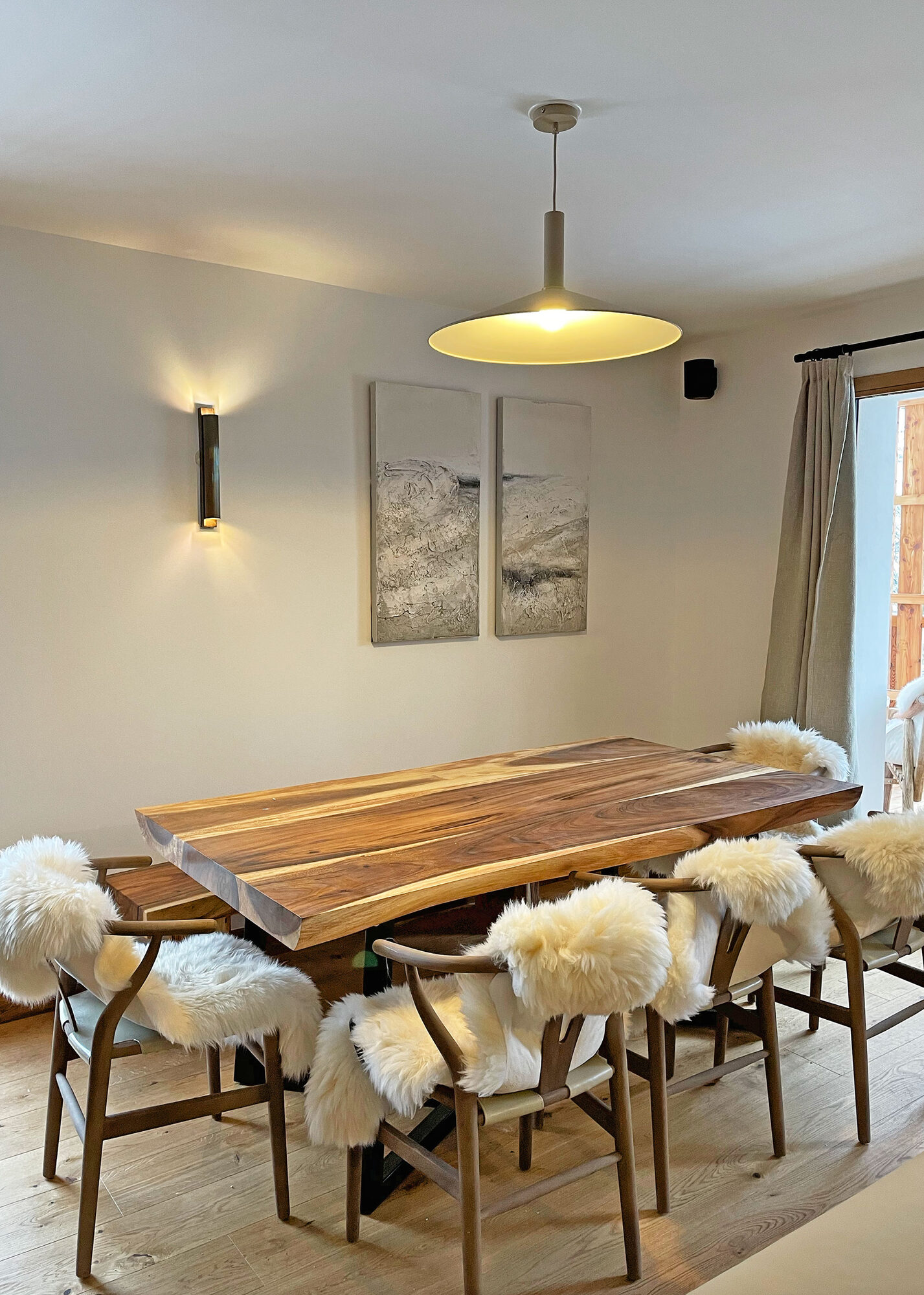
The dining room of Le Refuge des Anges was built for evenings like these. The suar wood table — warm, generous, spectacular — seats six with room for a board of cheese, a bottle of Chignin-Bergeron and an evening that begins at eight and ends somewhere after midnight.
The Harmony kitchen, fully equipped and including a wine cellar, is designed for guests who want to cook as well as those who want to bring in from the market. The morning market on the Place du Village — open year-round, busiest on Friday — is where Megève's finest producers and fromagères set up their stalls: Reblochon direct from the farm, wheels of Beaufort d'alpage, local honeys and mustards, charcuterie from the Beaufortain valley. The hosts of Le Refuge des Anges are happy to share which stalls are worth visiting and which producers are worth the short drive into the valley.
A wine and cheese visit to Megève works in any season. In winter, the classic alpine repertoire — tartiflette, raclette, fondue, Beaufort gratin — is the natural frame for a long evening in. In summer, the lighter cheeses and the whites of Apremont and Chignin pair beautifully with the herb-rich mountain air and the terrace of Le Refuge des Anges at sunset.
For cellar visits, the domains around Arbin and the Cave de Chignin receive visitors by appointment through most of the year and ship internationally. The Megève fromagerie in the old town stocks the widest local selection and will vacuum-pack for travel. For those who want a more structured gastronomic experience, a private cheese tasting with a local affineur can be arranged through the Megève Tourist Office.
The Savoie does not announce itself. It asks to be discovered at a table, over a meal that takes its time. Le Refuge des Anges is the right place to begin.
Stay at Le Refuge des Anges — Megève